
New Action for Energy Conservation, Carbon Reduction
By?YU?Haoyuan
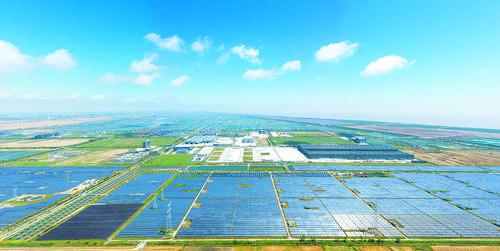
An aerial view of a low (zero) carbon-dioxide emission industrial park in Sheyang, Yancheng, east China's Jiangsu province. (PHOTO: XINHUA)
China's State Council recently released a two-year action plan aimed at energy conservation and carbon reduction to support the carbon peaking and carbon neutrality goals.
According to the plan, China is expected to achieve approximately a 2.5 percent reduction in energy consumption and a 3.9 percent reduction in carbon dioxide emissions per unit of GDP in 2024. The energy consumption per unit of added value of industrial enterprises above designated size will decrease by about 3.5 percent.
In 2024, the proportion of non-fossil energy consumption is targeted to be 18.9 percent. About 50 million standard coal will be saved and 130 million tons of carbon dioxide emissions will be reduced from energy-saving and carbon-reduction transformations in key areas and industries. In 2025, the proportion of non-fossil energy consumption is aimed to be 20 percent. This reflects China's efforts to meet the mandatory targets for energy conservation and carbon reduction in the 14th Five-Year Plan (2021-25) period.
The two-year plan (2024-25) clarifies 10 key tasks, such as controlling fossil energy consumption and strengthening carbon emission intensity management. The four fundamental aspects are ensuring low carbon in industries, housing, transportation and social infrastructure.
For industries
Fossil energy substitution and consumption reduction will be a priority. The government has called for strengthening efficient use of coal, promoting low-carbon transformation, and enhancing the energy conservation and carbon reduction capabilities of coal-fired power plants.
Efforts will be made to improve the flexibility of coal-fired power plants and their capacity for heat supply. It is expected that the scattered coal in key air pollution prevention areas will be eliminated by the end of 2025. China will also regulate oil consumption and promote the use of advanced bio-liquid fuels and sustainable aviation fuels.
The plan encourages developing non-fossil energy. China will increase its renewable energy consumption capacity and promote the consumption of non-fossil energy. Wind power, photovoltaic power, pumped storage and other forms of clean energy will be utilized to replace fossil fuels. The plan indicates that non-fossil energy will account for about 39 percent of the country's electricity generation by the end of 2025.
Moreover, measures such as output control and production capacity layout will be implemented in steel, petrochemical, non-ferrous metal, and other industries to achieve the ultimate goals of energy conservation and carbon reduction.
For housing
Efforts will be made to control the national cement clinker capacity, maintaining it at around 1.8 billion tons by the end of 2025. The government will develop green building materials and promote the use of energy-saving technology and equipment. Moreover, the energy-saving and carbon-reduction transformations in the building materials industry are expected to save about 10 million tons of standard coal and reduce carbon dioxide emissions by approximately 26 million tons.
China will accelerate the transformation of construction methods by developing prefabricated buildings and promoting intelligent construction. For example, the construction of building-integrated photovoltaics is encouraged. By the end of 2025, solar coverage of new public institution buildings and factories is expected to increase to 50 percent, and the renewable energy substitution rate for urban buildings will be raised to eight percent. China will also push for energy retrofit of existing buildings to enhance energy efficiency and reduce heat loss in urban heating networks.
For transportation
The construction of low-carbon transportation infrastructure and the transition to low-carbon transportation equipment will be promoted. By the end of 2025, carbon dioxide emission intensity in the transportation sector is expected to be reduced by 5 percent compared to 2020. Additionally, it will optimize the transportation structure, aiming to increase rail and waterway freight volumes by 10 percent and 12 percent respectively, while reducing comprehensive energy consumption per unit of converted turnover in rail transport by 4.5 percent compared to 2020.
For social infrastructure
Public institutions should lead by example in energy-saving and carbon reduction management. By the end of 2025, energy consumption per unit building area, carbon emissions per unit building area, and per capita comprehensive energy consumption in public institutions are expected to decrease by five percent, seven percent and six percent respectively compared to 2020. Energy-saving renovations will reduce coal consumption to below 13 percent and ensure that 80 percent of new key energy-consuming equipment meets advanced efficiency levels.
Additionally, upgrading and renovation of energy-using products and equipment will be accelerated. By 2025, the proportion of high-efficiency energy-saving products in industrial boilers, power station boilers, refrigeration equipment, and general lighting equipment is expected to significantly increase. Efforts will also be strengthened to recycle outdated products and equipment.