
Space Science Program for 2024-2050 Unveiled
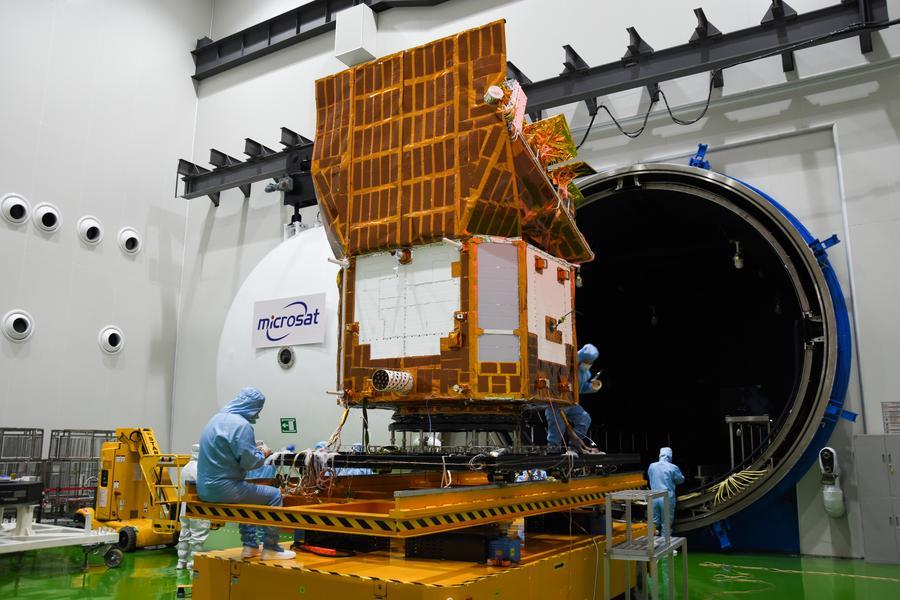
Exploring the vast universe has been an unremitting pursuit in human history. Currently, China's aerospace industry has accomplished remarkable progress. Sophisticated space applications in communication, navigation, and remote sensing satellites are boosting socioeconomic development.
As space science advances into a phase of innovative development, the first comprehensive national medium- and long-term development plan for space science (2024-2050) was unveiled by the Chinese Academy of Sciences (CAS), the National Space Administration and the China Manned Space Agency (CMSA) at a news briefing on October 15.
Three-stage roadmap
The plan will be the foundation of China's space science mission deployment and space science research for decades to come, CAS vice president Ding Chibiao said.
The overarching goal is to implement national space science missions, strengthen task-driven basic research, build a high-level talent pool for space science, and make original landmark achievements with international influence.
Breakthroughs are expected in five areas: extreme universe, space-time ripples, a panoramic view of solar-earth, habitable planets, and biological and physical sciences in space.
Seventeen areas will be given priority, such as dark matter and extreme universe, origin and evolution of the universe, and detection of cosmic baryonic matter.
The program outlines a three-stage roadmap for space science development.
In the first stage, from now to 2027, the main task will be space station operation, implementing the manned lunar exploration project, the fourth phase of the lunar exploration program and planetary exploration project.
Five to eight space science satellite tasks will be approved, and original achievements with important international impact will be produced.
During the second stage from 2028 to 2035, China will maintain the operation of the Chinese space station, implement manned lunar exploration and the International Lunar Research Station, carry out about 15 space science satellite tasks, and attain world-leading original achievements.
The third stage will run from 2036 to 2050. China will implement more than 30 space science tasks, and key areas in space science are expected to reach world-leading levels.
Filling the gap
"Focusing on frontier issues in space astronomy, China will launch a space telescope for sky survey, which is expected to make breakthroughs in cosmology, galaxy science, the Milky Way, and solar system celestial bodies," CMSA deputy director Lin Xiqiang said.
"Currently, we have planned scientific objectives in three major areas: lunar science, moon-based science, and resource exploration and utilization, covering nine key directions," he said.
Ding said that space science is the cornerstone of aerospace activities, which encompass another two elements — space technology and space applications. It not only pushes the frontiers of human knowledge but also drives the development of space technology.
"But China's space science research is still in its infancy, with a relatively small number of space science satellites. Some gaps need to be filled to become an aerospace powerhouse," Ding said.
The plan will coordinate domestic scientific research forces and deploy major sci-tech tasks, so that world-class major scientific achievements can be achieved in fields with foundations and advantages.
"We will deepen international cooperation and space science exchanges to ensure that the achievements better benefit humankind," said Wang Chi, director of the National Space Science Center, CAS.
China will facilitate cooperative research among global scientific communities, and share scientific data more widely to encourage major scientific achievements, Wang added.