
Digital Earth, Big Data & AI for Sustainable Development: Digital Earth Initiative for SDGs Launched at 2025 WSTDF
On the afternoon of 28 October 2025, the Thematic Session on Digital Earth Supporting Sustainable Development was convened during the 2025 World Science and Technology Development Forum (WSTDF) in Beijing, aiming to respond to the growing global call for a paradigm shift in digital technologies, particularly at the frontier where big data and AI meet Earth sciences, to eliminate data and technology barriersand help narrow the remaining gaps in achieving the SDGs.
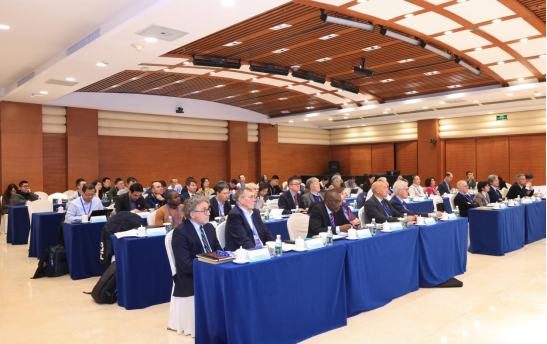
Hosted by the International Society for Digital Earth (ISDE), the session gathered up to 70 leading figuresand representativesfrom research institutes and universities of 19 countriesand relevant UN agencies and international organizations, to tackle the problems along niche opportunities brought by emerging science and technology trends, with a consensus on the Digital Earth Initiative for the Sustainable Development Goals.
At the opening ceremony of the Thematic Session, Dr. Richard Simpson, President of the International Society for Digital Earth (ISDE); Prof. Huadong Guo, Academician of the Chinese Academy of Sciences (CAS), Director General of the International Research Center of Big Data for Sustainable Development Goals (CBAS), and Honorary President of ISDE; Prof. Lena Halounová, President of the International Society for Photogrammetry and Remote Sensing (ISPRS); and Prof. Kamal Labbassi, President of the African Association of Remote Sensing of the Environment (AARSE) delivered welcome remarks. Prof. Changlin Wang, Vice President of ISDE, moderated the openingceremony.
In his welcome remarks, Dr. Richard Simpson, President of ISDE, conceptualized Digital Earth as a federated infrastructure of cyber-physical systems, rather than a monolithic platform. Its purpose is to enable planetary-scale understanding by integrating capabilities to sense, simulate, and coordinate. This vision is operationalized through a newly approved architecture of twelve interlocking thematic frameworks, structured across three tiers: foundational systems, embedded infrastructure, and human-centric systems. He stressed a dedicated framework within this architecture focuses on SDG reporting, explicitly highlighting climate action (SDG 13).

Five keynote presentations cut to the chase, offering an in-depth look at the unleashed potential of digital technologies, especially Digital Earth technologies, such as GeoAI, big Earth data, and geospatial toolkits, for bridging gaps in the SDGs. Invited speakers included Academician Prof. Huadong Guo, Prof. Hiromichi Fukui, Former Vice President of the Chubu University, Japan, Prof. Maria Antonia Brovelli, Ex-Chair of the UN Open GIS Initiative, Prof. John Wilson, Founding Director of Spatial Sciences Institute of the University of Southern California, USA, and Dr. Nadine Alameh, Board member of the Private Sector Network of UN Committee of Experts on Global Geospatial Information Management (UN-GGIM).
In the keynote of“Harnessing the Power of Digital Technologies for Sustainable Development Goals,” Prof. Huadong Guo showcased a comprehensive suite of digital technologies advancing the SDGs, including initiatives led by CBAS such as the SDGSAT-1 Satelliteand its Open Science Program, and the newly launched LingXi·SDG, an AI system dedicated to sustainable development built on over 5PB of data resources. He was glad to mention that the Global-Scale Sustainable Development Scientific Monitoring Report (2025) was released at the 2025 WSTDF opening ceremonyright the day before, which reviews a decade of technological progress in overcoming traditional data limitations and delivering comparable monitoring results through big Earth data. In line with these efforts, the Digital Sustainable Development Goals Programme (DSP), initiated by CBAS and approved by UNESCO, has garnered support from 63 institutions across 32 countries and will continue to play a leading role in shaping the post-2030 vision.

In his keynote titled “Digital Earth Technology for Sustainable Development Goals- Towards Social Implementation of Digital Earth,” Prof. Hiromichi Fukui reviewed the key advances in Digital Earth research and its transformative impact on climate change, biodiversity, and other global challenges.He highlighted how Digital Earth toolkits can drive sustainability progress through the Land Cover Breakthrough (LCB) Project. He believed the Land Cover Breakthrough (LCB) group harnesses AI foundation models and high-quality training data to improve annual satellite-based mapping of natural land cover by contextualizing pixel-level classifications within regional ecosystems. By rapidly producing ecoregion-based quality datasets, the project can significantly reduce costs and accelerate progress toward the global 30×30 conservation goal. Reaffirming his belief, he stressed that “we need a world of collaboration,” a message that resonated with all.


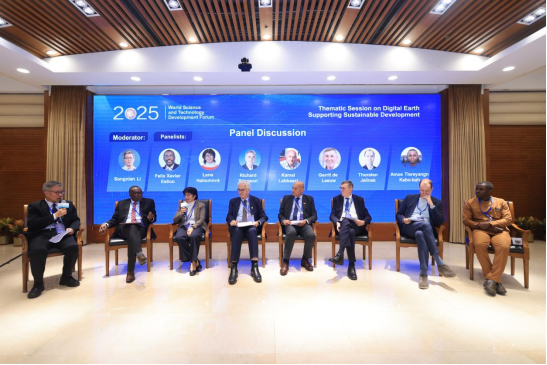
A more theme-focused panel discussion later closely examined the innovative use of Digital Earth technologies, along with key principles to guide more informed stewardship of geospatial technologies in both accelerating and elevating the quality of SDGs. Invited panelists included Dr. Richard Simpson, Prof. Lena Halounová, Prof. Kamal Labbassi, Mr. Felix Xavier Estico (UN SG’s 10 High-level Representatives to Promote Science, Technology and Innovation for the SDGs), Prof. Gerrit de Leeuw (Royal Netherlands Meteorological Institute), Dr. Thorsten Jelinek (Center for Digital Governance, Hertie School, Germany), and Dr. Amos Tiereyangn Kabo-bah (University of Energy and Natural Resources, Ghana).
Discussions provided concrete evidence of how AI and big data are transforming SDG 13 (Climate Action), SDG 11 (Sustainable Cities and Communities), and SDG 16 (Peace, Justice and Strong Institutions)through more robust data infrastructures. The panel also called for globally consistent frameworks on digital governance, ethics, and equity to mitigate emerging risksthrough multi-faceted approaches.The unique potential of Africa and the small island developing states was highlighted repeatedly, alongside calls for stronger guidance and partnerships under broader international frameworks and governmental cooperation. Prof. Songnian Li, Chair of the Academic Network of UN-GGIMmoderated the discussion.
The session culminated in the launch of the Digital Earth Initiative for the Sustainable Development Goals, which reaffirms the Digital Earth community’s commitment to transforming data and knowledge into informed, transparent, and ethical decision-making to advance the UN SDGs. The Initiative supports the SDGs“not as static targets but as dynamic relationships among climate, water, energy, nature, and society.”In this context, the cross-cutting digital technologies have become even more crucial.
It adopts the ISDE Thematic Framework: Digital Earth as a Strategic Intelligence and Decision Theatre, promising to establish pilot Strategic Intelligence and Decision Theatres across priority SDG domains while upholding ethical governance and transparency. The newly launched Initiative will guide ISDE’s 2026 agenda, mobilizing its Working Groups, the partnering network, and open repositories toward for SDG-linked indicator improvement.

The Thematic Session on Digital Earth Supporting Sustainable Development, one of ten parallel sessions at the 2025 World Science and Technology Development Forum (WSTDF), is closely aligned with the forum’s overarching theme, “AI for Science and Development (AI4SD),” showcasing concrete digital solutions in the geospatial domain. The WSTDF, a flagship sci-tech event launched by CAST in 2019, welcomed around 800 delegates from government, academia, education, and industry this year.

The session also formed part of CAST’s International Month 2025, following the endorsement of the Openness, Cooperation and Trust Initiative by 260 science and technology communities worldwide.